18/1.13
18/1.13 18/1.13
18/1.13 18/1.13 18/1.13 18/1.13
Reviews
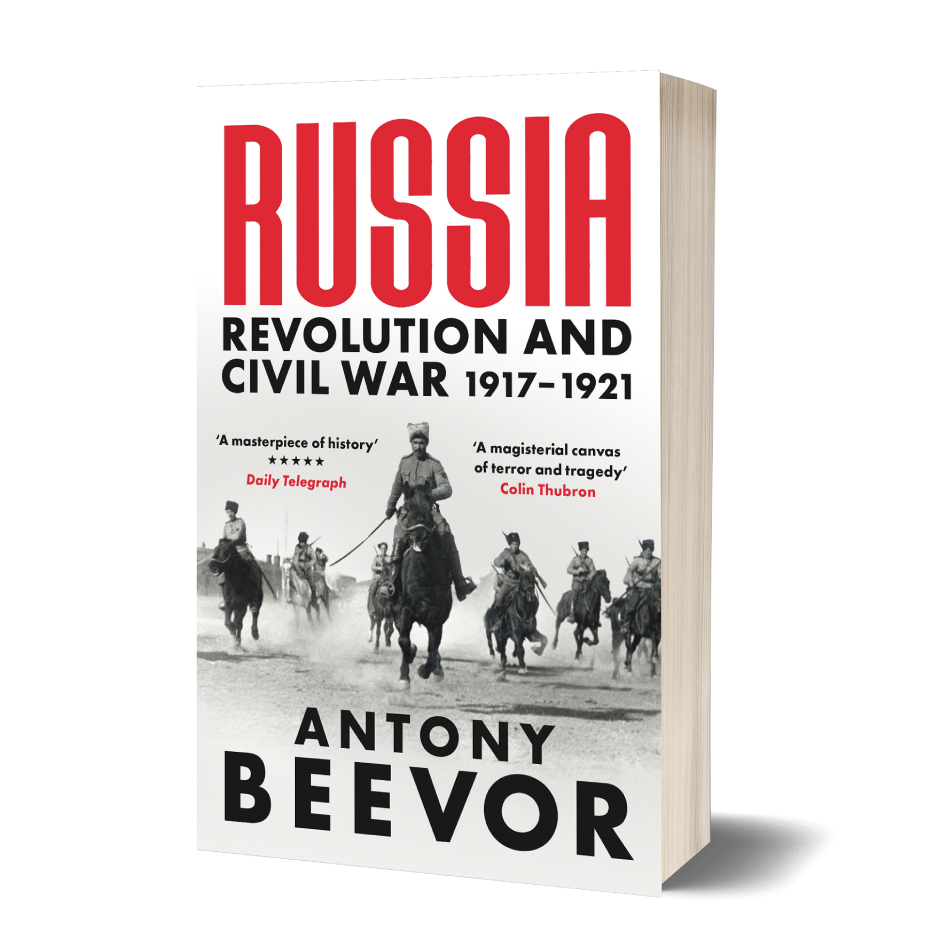
“Beevor, best known for his formidable book Stalingrad, commands authority because his research is comprehensive and his conclusions free of political agenda. He is a skilled writer, but his prose is is not what makes his books special. Rather, it is the confidence that his authority conveys – one senses that he knows his subject as well as anyone. He allows his evidence to speak for itself. . . This is an unmerciful book, agonising, yet always irresistible.” Gerard DeGroot, The Times
“A masterpiece of history and a harrowing lesson for today. . . Antony Beevor’s grimly magnificent new book. . . is a hugely complex story and Beevor tells it supremely well. The book is ground-breaking in its use of original evidence from many archives.” Noel Malcolm in The Daily Telegraph *****
“What makes the new book so readable is its structure. . . Beevor’s short chapters break up the action to ensure they are digestible while also pointing a clear path through the dark fog of this brutal war. . . This combination of clarity with vividness is Beevor’s defining strength as a historian.” Misha Glenny in The Sunday Times
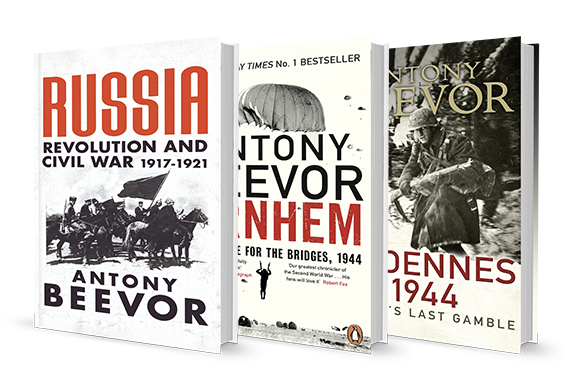
“My book of the year has to be Antony Beevor’s magisterial Russia: Revolution and civil war, 1917-1921 which brings into harrowing focus four chaotic years in a theatre of conflict stretching from Poland to the Pacific. Often the study of this period centres on politics and ideology, but Beevor depicts the raw reality of its warfare with the skill of a military historian, buttressed by new material from Russian archives. Enfolded into the grander narrative is the experience of its humbler participants and victims, until the confusion and brutality of this time, leaving 10 million dead, attain a vivid and terrible force. It is a great achievement.” Colin Thubron in The Times Literary Supplement
“Antony Beevor’s extraordinary book strips the romance from a revolution too often idealised. . . It’s unmerciful, agonising yet irresistible.” G deGroot, The Times Book of the Year
“Antony Beevor’s Russia: Revolution and civil war, 1917-1921 is an extraordinary book, hugely impressive for its in-depth research, narrative drive and deft analysis of politics and warfare. As this grimmest of civil wars draws to a close, one ends up richly informed but stunned by the scale of human suffering, and contemplating the possibilities of many might-have-beens.” Noel Malcolm in the Times Literary Supplement
Read More
Advance Comment
“A completely riveting account of how the Russian Revolution, which started with such high hopes and idealism, degenerated into a tangle of civil conflicts marked by hideous cruelty on all sides. Antony Beevor brings his great gifts for narrative and his deep interest in the people who both make history and suffer it to illuminate that crucial period whose consequences we are still living with today.” Margaret MacMillan
“Brilliant and utterly readable” Antonia Fraser
“In Stalingrad, Berlin and The Second World War, Antony Beevor transformed military history by evoking the experiences of those who fought and suffered in some the greatest wars of the twentieth century. Now he has given us what may be his most brilliant book to date - a masterpiece of historical imagination, in which the tragedy and horror of this colossal struggle is recaptured, in its impact on everyday life as well as its military dimensions, as never before. This is a great book, whose depiction of savage inhumanity speaks powerfully to our present condition. ” John Gray
Read More
Biography

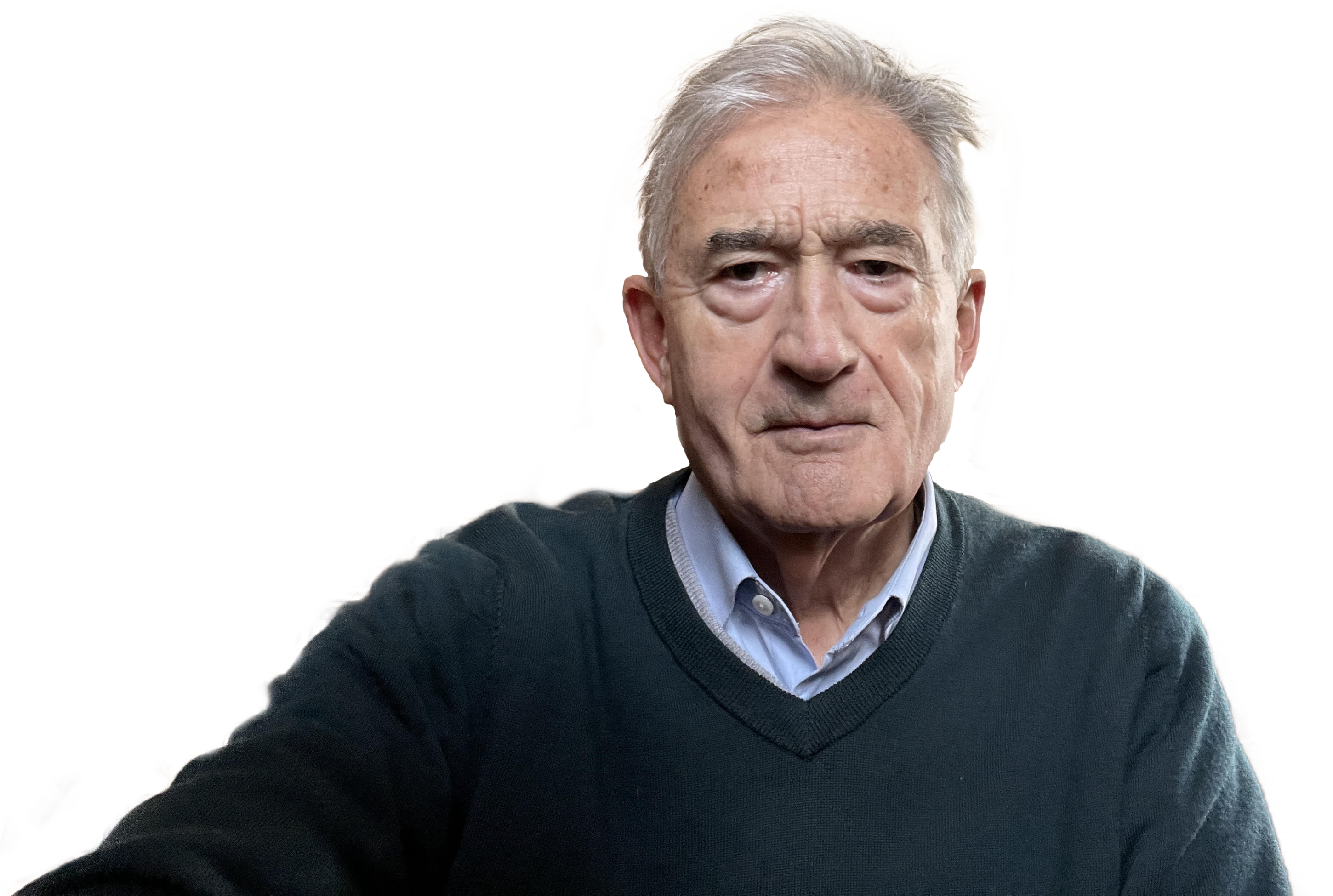
Antony Beevor: The number one bestselling historian in Britain

Beevor’s books have appeared in thirty-seven languages and have sold nine million copies. A former chairman of the Society of Authors, he has received a number of honorary doctorates. He is also a visiting professor at the University of Kent and an Honorary Fellow of King’s College, London. He was knighted in 2017.

Read More   Other Titles

18/1.13
Speaking

Upcoming Events

See full calendar

Updates

Latest News

18/1.13 ((free)) • Free Forever

Emily, a curious and determined young woman, had always been fascinated by the legend. She was a mathematician at heart, with a love for numbers and their mysteries. One day, while rummaging through the attic of her family's old Victorian home, Emily stumbled upon an ancient diary belonging to her great-grandfather, a renowned mathematician and alchemist.

In the quaint town of Willowdale, nestled in the heart of the countryside, there was an old legend about a peculiar ratio: 18 to 1.13. It was said that if one understood the significance of this fraction, they would unlock a secret that would change their life forever. The townsfolk often whispered about it in hushed tones, but no one knew what it truly meant.

Mr. Orion revealed to Emily that her great-grandfather had encoded the ratio as a guide to this garden, a place where one could experience a profound shift in perception. The ratio, 18/1.13, was more than just a mathematical operation; it was a key to a hidden world, a world that balanced the physical and spiritual. 18/1.13

Upon arriving at Mr. Orion's cottage, Emily shared her findings and asked for his insight. With a warm smile, he led her to a small garden behind his house, where 15.93 kilograms (or approximately 35 pounds) of a rare, exquisite flower bloomed. The fragrance of these flowers was known to induce a transformative experience in those who inhaled it deeply.

The next morning, Emily decided to visit the town's elderly sage, Mr. Orion, who was known for his wisdom and knowledge of local legends. As she approached his cottage, she noticed that the distance from her home to his was exactly 18 kilometers. The journey took her 1.13 hours on foot, walking through a path she had never noticed before. Emily, a curious and determined young woman, had

Intrigued, Emily calculated the ratio on her calculator and was surprised to find that it indeed approximated to 15.93. She began to ponder the deeper meaning behind these numbers.

And so, the story of the fraction spread, not as a mere mathematical curiosity but as a tale of how numbers can lead us to secrets and wonders we never imagined. In the quaint town of Willowdale, nestled in

"In my pursuit of the universal secrets, I discovered a ratio that transcends the material world: 18/1.13. It represents the balance between the tangible and the intangible, the seen and the unseen. Eighteen, a number of abundance and harmony, divided by 1.13, a seemingly insignificant decimal. Yet, this fraction equals approximately 15.93, a number that holds the essence of transformation."

Interviews & News