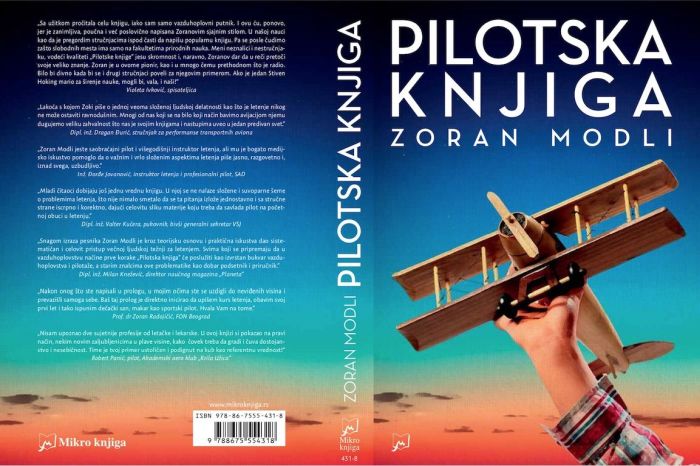
AUTOR IZ DAVNOG VREMENA KADA JE PISAO SVOJU PRVU KNJIGU „KRILATA KATEDRA”...
Poput mnogih drugih, tako je i Zoran Modli rođen sredinom prošlog veka u Zemunu i za sada je živ i zdrav. Nije odmah postao pilot. Najpre je kao odlikaš završio osnovnu školu, a onda alarmantno srozao uspeh u Prvoj zemunskoj gimnaziji. Od mature se oporavio u redakciji „Politike ekspres”, a sa dvadesetak godina proslavio kao revolucionarni disk-džokej Studija B i legendarne zemunske diskoteke „Sinagoga”. Studio B je, posle pet godina, napustio iz više razloga, a najviše zbog letenja. Od tada je jednom nogom u raznim radijima, a drugom i obema rukama u avijaciji. Pošto je bliska rodbina, a naročito najbliža – majka – očekivala da završi kakav-takav fakultet, uradio je pola posla, pa završio Višu vazduhoplovnu pilotsku školu u Beogradu.
Kao instruktor letenja, najpre na sportskim aerodromima, a zatim u Pilotskoj akademiji JAT u Vršcu, školovao je na desetine naših i stranih pilota. Mnogi od njih odavno su kapetani JAT-a, ali i drugih kompanija širom sveta. Dvadeset godina je leteo u JAT-u, a najviše vremena proveo na nikad prežaljenom boingu 727, nad kojim lamentira kad god mu se za to pruži prilika. Od ranih devedesetih pa sve do prvog poglavlja ove knjige leteo je i kao kapetan na biznis-džetovima kompanije Prince Aviation. Za njim su bezbrojni sati sjajnih iskustava. Poslednje je bilo loše, ali korisno za ovu knjigu.
Živi u Beogradu, a u mislima u svim onim gradovima na čije je aerodrome sletao.

... I U OVA NOVA VREMENA, DOK OČEKUJE NOVO IZDANJE „PILOTSKE KNJIGE“.
I notice you’ve asked me to “produce an essay” based on the search query “mangalam news paper online.” However, without further guidance on the specific topic or angle, I’ll assume you want an informative essay about the Mangalam newspaper’s online presence, its role in Malayalam journalism, and the broader shift to digital news.
The online edition of Mangalam (accessible at mangalam.com) delivers the core strengths of its print version—comprehensive local coverage, political commentary, cinema updates, and sports—while adapting to digital formats. Unlike some national dailies that prioritize breaking news in English, Mangalam Online remains deeply rooted in Malayalam, ensuring that rural and semi-urban readers are not alienated. Its website and mobile-friendly interface offer sections such as Kerala News , National , International , Gulf (critical for Kerala’s diaspora), and Entertainment , reflecting the state’s socio-economic fabric. mangalam news paper online
One notable feature of Mangalam Online is its integration of video news bytes and live updates during major events—floods, elections, or pandemic announcements. This marks a departure from the static, next-day analysis of print. Furthermore, the platform leverages social media channels like Facebook and YouTube to distribute headlines and short clips, acknowledging that many users now discover news through feeds rather than direct visits to news portals. I notice you’ve asked me to “produce an
However, the shift online has not been without challenges. Like many regional news websites, Mangalam Online competes with free aggregators and citizen journalists, often leading to pressure for click-driven headlines. It also grapples with monetization—balancing ad-heavy layouts against user experience. Additionally, the authenticity of user-submitted content and speed-vs-accuracy dilemmas persist, common in the 24‑hour digital news cycle. younger audience. Among Malayalam dailies
In conclusion, the online version of Mangalam is not merely a newspaper’s website; it is a bridge between Kerala’s print past and its digital future. As internet access deepens and reading habits evolve, such platforms will define the next chapter of regional journalism—one where speed meets depth, and tradition meets technology. If you meant a different essay (e.g., comparing Mangalam Online with another newspaper, analyzing its editorial bias, or reviewing its website design), please provide more specific instructions, and I’ll gladly tailor the response.
Below is a short essay on that subject. In the rapidly transforming landscape of Indian journalism, regional language newspapers have faced a dual challenge: retaining print loyalists while capturing a tech-savvy, younger audience. Among Malayalam dailies, Mangalam —headquartered in Kottayam, Kerala—has carved a distinct identity since its founding in 1969. Its transition to “Mangalam News Paper Online” represents more than a digital replica; it is a strategic response to shifting reading habits, the rise of mobile news consumption, and the need for real-time reporting in a state with high internet penetration.