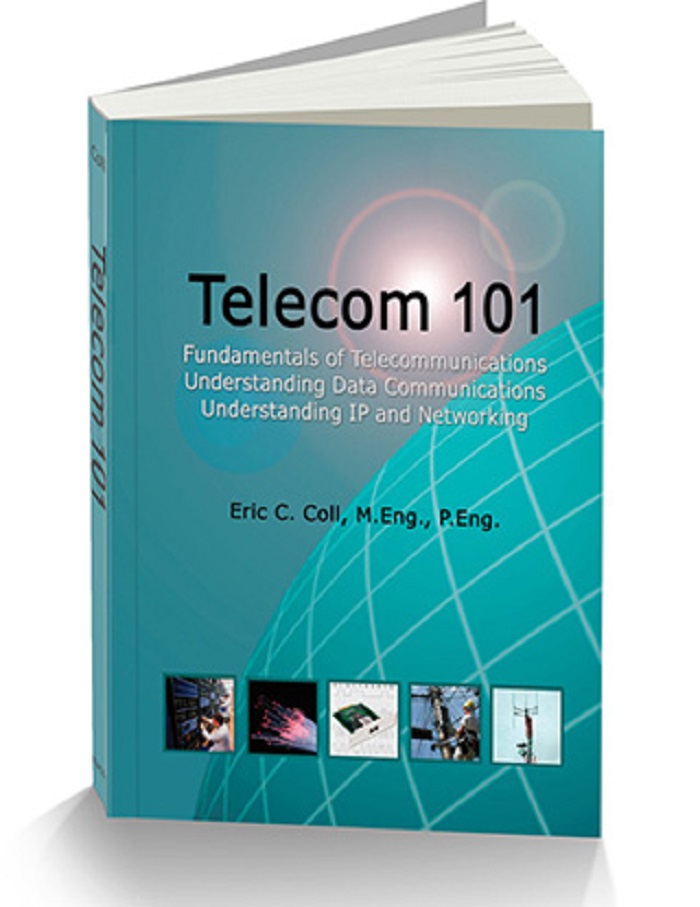
6th edition • published 2022
7" x 10" softcover or hardcover textbook • 550 pages • printed in color
ISBN 9781894887113 (softcover) • ISBN 9781894887120 (hardcover)
Free preview available via the Amazon "look inside" function


eBook (ISBN 9781894887137) available from:



All Major Telecommunications Topics covered ... in Plain English. Packed with up-to-date information and covering all major topics. Telecom 101 is an authoritative day-to-day reference and an invaluable textbook on telecom.
Updated and revised throughout, Telecom 101: Sixth Edition includes the materials from the most recent version of Teracom's popular Course 101 Broadband, Telecom, Datacom and Networking for Non-Engineers, and more topics.
Telecom 101 serves as the study guide for the TCO, Telecommunications Certification Organization, Certified Telecommunications Analyst (CTA) certification, including all required material for the CTA Certification Exam, except the security module.
Telecom 101 brings you completeness, consistency and unbeatable value in one volume.
Our philosophy is simple: Start at the beginning. Proceed in a logical order. Build concepts one on top of another. Speak in plain English. Avoid jargon.
Knowledge and understanding to last a lifetime... Build a solid base of structured knowledge and fill in the gaps. Cut through the doubletalk, demystify the jargon, bust the buzzwords. Understand how everything fits together!
The ideal book for anyone needing an understanding of the major topics in telecom, IP, data communications, and networking. Clear, concise, organized knowledge ... available in one place!
Before SIAP, a satellite imagery analyst might have to log into a USGS portal, a commercial provider’s archive, and a military database separately, reformatting search coordinates each time. SIAP standardized the . It defines how a client (the user’s portal) asks a server (an image archive) for pictures based on spatial, temporal, and spectral parameters.
In the digital age, data is the new geography. Just as physical explorers once sought passes through mountain ranges to reach new lands, modern analysts seek gateways to navigate the overwhelming expanse of distributed information. These gateways are known as portals . When applied to the rigorous standards of geospatial intelligence, specifically the Standards for Image Archive Portals (SIAP) , the humble portal transforms from a simple webpage into a disciplined, interoperable gateway for observing the world. The Nature of the Portal A portal, in information technology, is more than a website. It is a curated gateway that aggregates content from diverse sources into a unified interface. While consumer portals like Yahoo or iGoogle have faded, enterprise and defense portals have become critical infrastructure. They provide three essential functions: access (single sign-on), integration (pulling data from silos), and presentation (customized views for the user). portalsiap
The greatest challenge, however, is cognitive overload. A portal that returns 10,000 satellite images in response to a simple query is technically successful but practically useless. Therefore, modern SIAP portals now integrate AI and machine learning to pre-filter results—showing the user only the images that contain changes, moving objects, or specific features. The concept of "Portalsiap" represents a quiet revolution. In an era of data deluge, we do not need more information; we need better thresholds to cross into the information we actually require. The SIAP framework gives portals a disciplined language, turning chaotic archives into orderly, queryable resources. As we move toward real-time global sensing, the portal is no longer just a window on the world—it is the door through which reality, measured in pixels and metadata, enters the decision-making room. Understanding this relationship is essential for anyone who seeks to see the big picture from a million separate frames. Before SIAP, a satellite imagery analyst might have
However, a portal without standards is like a door with no hinges—it looks like an entrance but leads nowhere. This is where SIAP enters the narrative. The Standards for Image Archive Portals (SIAP) were developed by the Open Geospatial Consortium (OGC) to solve a specific problem: How does a user query multiple disparate image archives simultaneously without learning a new interface for each one? In the digital age, data is the new geography
Before SIAP, a satellite imagery analyst might have to log into a USGS portal, a commercial provider’s archive, and a military database separately, reformatting search coordinates each time. SIAP standardized the . It defines how a client (the user’s portal) asks a server (an image archive) for pictures based on spatial, temporal, and spectral parameters.
In the digital age, data is the new geography. Just as physical explorers once sought passes through mountain ranges to reach new lands, modern analysts seek gateways to navigate the overwhelming expanse of distributed information. These gateways are known as portals . When applied to the rigorous standards of geospatial intelligence, specifically the Standards for Image Archive Portals (SIAP) , the humble portal transforms from a simple webpage into a disciplined, interoperable gateway for observing the world. The Nature of the Portal A portal, in information technology, is more than a website. It is a curated gateway that aggregates content from diverse sources into a unified interface. While consumer portals like Yahoo or iGoogle have faded, enterprise and defense portals have become critical infrastructure. They provide three essential functions: access (single sign-on), integration (pulling data from silos), and presentation (customized views for the user).
The greatest challenge, however, is cognitive overload. A portal that returns 10,000 satellite images in response to a simple query is technically successful but practically useless. Therefore, modern SIAP portals now integrate AI and machine learning to pre-filter results—showing the user only the images that contain changes, moving objects, or specific features. The concept of "Portalsiap" represents a quiet revolution. In an era of data deluge, we do not need more information; we need better thresholds to cross into the information we actually require. The SIAP framework gives portals a disciplined language, turning chaotic archives into orderly, queryable resources. As we move toward real-time global sensing, the portal is no longer just a window on the world—it is the door through which reality, measured in pixels and metadata, enters the decision-making room. Understanding this relationship is essential for anyone who seeks to see the big picture from a million separate frames.
However, a portal without standards is like a door with no hinges—it looks like an entrance but leads nowhere. This is where SIAP enters the narrative. The Standards for Image Archive Portals (SIAP) were developed by the Open Geospatial Consortium (OGC) to solve a specific problem: How does a user query multiple disparate image archives simultaneously without learning a new interface for each one?
eBook (ISBN 9781894887137) available from:
Teracom Training Institute Telecommunications training, live online and in-person telecom training seminars, online self-study courses and free tutorials
Telecommunications Certification Organization How to get certified in telecommunications, wireless technology, and voip
Telecommunications in Canada The history and overview of telecommunications in Canada