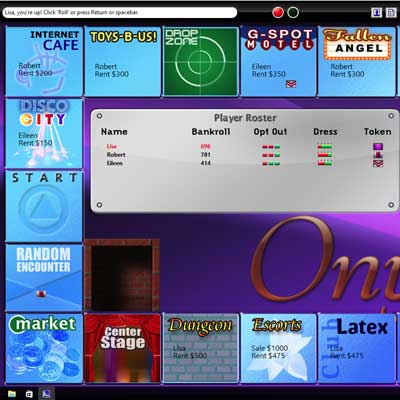
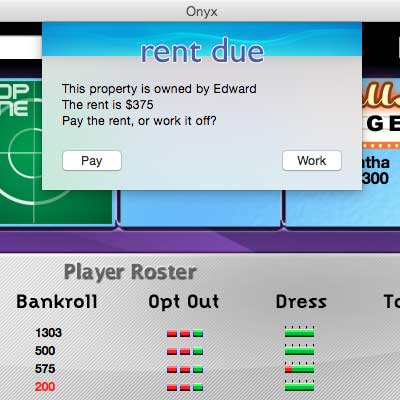
Onyx is a computer sex game. Move around the board buying up properties. If you land on a property that is owned by somebody else, you must either pay rent or work off the debt! Players work off debt with all kinds of intimate actions, from mild to kinky. As the game progresses, so does the action! Play with people you are intimate with, or want to be!
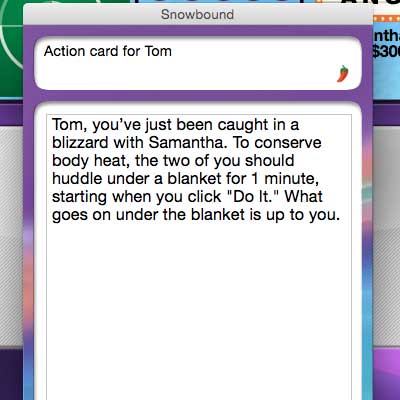
You can work off the debt by being assigned fun, sexy erotic actions.
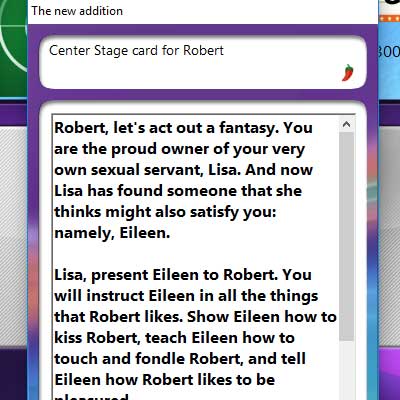
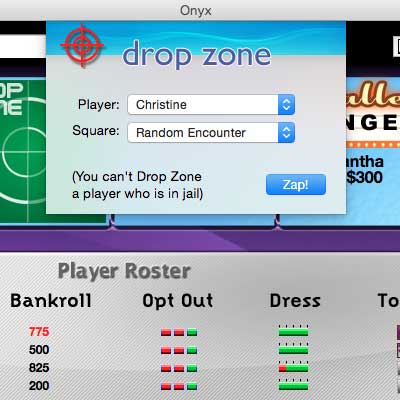
Look out for special squares! If you land on the Torture Chamber, you must draw a "torture card" with an erotic torture on it. At Center Stage, you are put on display; in the Random Encounter square, you will be assigned an erotic action with another player; and on the Fate squares, the luck of the draw dictates your fate.
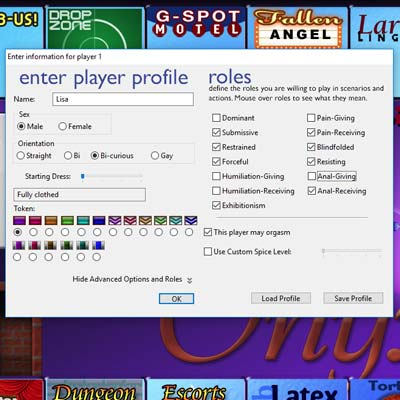
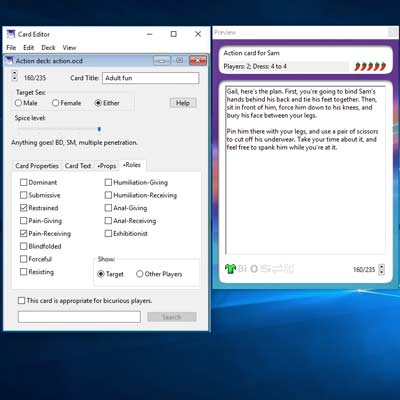
You control the "spice" of the erotic actions, from harmless fun to wild, anything-goes kink. You choose "roles," which tell the game what kinds of actions you prefer to be involved in. If you don't like being tied up, just tell Onyx that you will not accept the "bondage" role.
Onyx 3.6 and earlier did not work on Macs requiring 64-bit native apps. Onyx 3.7 now works on modern Macs, and is optimized to run natively on Apple Silicon Macs. A version of Onyx that runs natively on Windows ARM devices is also available!
UPDATE: Some Mac users were reporting an error saying “Onyx 3.7.app can’t be opened because Apple cannot check it for malicious software.” I have updated the app to address this issue; it should work properly now.
Onyx runs on Macs (OS X 10.14 or later), Windows (Windows 7 or later), Windows for ARM (Windows 11 or later), and x86 Linux (GTK 2.0+).
Onyx is available for free download. The free version can only be played on the mildest two "spice level" settings. Onyx can be registered by paying the $35 shareware fee. Registration gives you a serial number to unlock the full version, and it also gives you the Card Editor program, which you can use to create your own card decks.
Onyx contains explicit descriptions of sexual acts. Some of the high-level actions in Onyx describe erotic actions like bondage and power exchange.
IF YOU ARE OFFENDED BY SEXUAL ACTIONS, BEHAVIOR, OR DESCRIPTIONS, DON'T DOWNLOAD THIS SOFTWARE!
If you are under the legal age of consent or live in a place where this material may be restricted or illegal, YOU SPECIFICALLY DO NOT HAVE A LICENSE TO OWN OR USE THIS COMPUTER PROGRAM. There is absolutely no warranty of any kind, expressed or implied. Use it at your own risk; the author disclaims all responsibility for any kind of damage to your computer, your car, your refrigerator, or to anything else.
By downloading Onyx, you certify that you are an adult, age 18 or over, and that you consent to see materials of a sexual nature.
Unlike ext4 or NTFS, VMFS does not have a native "Trash/Recycle Bin" visible through the vSphere Client. However, under certain conditions, deleted files can be recovered using low-level tools.
1. Introduction VMFS (Virtual Machine File System) is VMware's clustered file system used to store virtual machines (VMDKs, VMX, logs, etc.) on shared block storage (SAN, iSCSI, or local disks). Accidentally deleting a virtual machine file (e.g., a .vmdk or .vmx ) is a common administrative mistake.
hexdump -C /tmp/vmfs_dump.raw | grep "44 4b 4d 56" Expected header start (little-endian):
# Disk DescriptorFile version=1 If you find the start offset:
sudo vmfs-undelete /dev/sdX1 /recovery_folder This scans for orphaned file entries. If you know the filename or extension:
dd if=/dev/sdX1 of=recovered.vmdk bs=512 skip=START_BLOCK count=BLOCKS This is tedious and only works for non-fragmented files. | Action | Purpose | |--------|---------| | Enable VMFS undelete (VMFS5/6 only) | esxcli storage vmfs undelete enable -l datastore1 | | Use snapshots + backups | Primary recovery method | | Set storage vMotion before deletions | Move critical VMs off datastore | | Configure trash can (NFS only) | Not native to VMFS | | Lower DeleteTimeout (advanced param) | Prevents accidental bulk deletes | Check if undelete is supported esxcli storage vmfs undelete status -l datastore_name If enabled, use:
Unlike ext4 or NTFS, VMFS does not have a native "Trash/Recycle Bin" visible through the vSphere Client. However, under certain conditions, deleted files can be recovered using low-level tools.
1. Introduction VMFS (Virtual Machine File System) is VMware's clustered file system used to store virtual machines (VMDKs, VMX, logs, etc.) on shared block storage (SAN, iSCSI, or local disks). Accidentally deleting a virtual machine file (e.g., a .vmdk or .vmx ) is a common administrative mistake.
hexdump -C /tmp/vmfs_dump.raw | grep "44 4b 4d 56" Expected header start (little-endian):
# Disk DescriptorFile version=1 If you find the start offset:
sudo vmfs-undelete /dev/sdX1 /recovery_folder This scans for orphaned file entries. If you know the filename or extension:
dd if=/dev/sdX1 of=recovered.vmdk bs=512 skip=START_BLOCK count=BLOCKS This is tedious and only works for non-fragmented files. | Action | Purpose | |--------|---------| | Enable VMFS undelete (VMFS5/6 only) | esxcli storage vmfs undelete enable -l datastore1 | | Use snapshots + backups | Primary recovery method | | Set storage vMotion before deletions | Move critical VMs off datastore | | Configure trash can (NFS only) | Not native to VMFS | | Lower DeleteTimeout (advanced param) | Prevents accidental bulk deletes | Check if undelete is supported esxcli storage vmfs undelete status -l datastore_name If enabled, use: